Technical Description Of The Owala Free SIP Water Bottle
Omar Ramirez
Department of English, City College of New York
ENGL 21007 Writing For Engineers
The City College of New York
Professor Elizabeth von Uhl
April 9, 2026
Table of Contents
Historical Background of Reusable Water Bottles……..3
Overview of Owala as an Innovation…………………4
4.1 Exterior Structure (Body)…………………….5
4.2 Lid System………………………………….6
4.3 The FreeSip Drinking Mechanism………………..7
4.4 The Insulation System………………………..8
Bottle Functions …………………9
Conclusion………………………………………10
References………………………………………11
Historical Background of Reusable Water Bottles
Hydration is one of the most important things in order to remain healthy. Sometimes it’s hard to stay hydrated and drink the healthy amount of water. Nobody wants to carry a huge jug of water in order to remain hydrated; that’s where the water bottle comes in. Water bottles have been around since the 17th century.
One of the first accounts of the water bottle is in the United Kingdom in 1622, when people would put water from the holy well into glass bottles, in order to save people the trip, and instead be able to easily access it. Although these glass bottles made it easier ot access water, they were a hassle to carry around, and they were a bit costly to produce. Mallett, S. (2023, January 8). The history of water bottles. Just Bottle. As a result, the plastic water bottle was introduced in the 20th century.
Plastic water bottles removed all the cons that the glass bottles had, and made production costs go down, and they made carrying water easier. Although the plastic water bottle was cheap to produce and easy to carry around, this led to it having negative effects on the environment. After people were done with these bottles, they would dispose of them, and they would end up in landfills or in our oceans. In order to combat these environmental issues, the stainless steel bottle was born.
Stainless steel water bottles are environmentally friendly, reusable, and durable.
Now, in the current landscape of the world, reusable water bottles have become extremely relevant. Everywhere you go, there’s someone with a reusable water bottle, and if you look on social media, it seems like there’s a new trending water bottle every few months or so; you can’t escape their massive presence. As the reusable water bottle market continues to grow, more and more companies are trying to introduce their own iteration; some are small, some are big, some are made with plastic, some are made with steel. These bottles come in a seemingly endless variety of iterations.
Stainless steel water bottles are environmentally friendly, reusable, and durable.
Now, in the current landscape of the world, reusable water bottles have become extremely relevant. Everywhere you go, there’s someone with a reusable water bottle, and if you look on social media, it seems like there’s a new trending water bottle every few months or so; you can’t escape their massive presence. As the reusable water bottle market continues to grow, more and more companies are trying to introduce their own iteration; some are small, some are big, some are made with plastic, some are made with steel. These bottles come in a seemingly endless variety of iterations.
Overview of Owala as an Innovation
Although there are plenty of bottles to choose from, the bottle that stands out the most amongst these is the Owala Free sip. The Owala free sip Water bottle is a modern-day hydration device that was first introduced in 2020. It was designed by Steve and Kim Sorensen in order to improve convenience, temperature retention, and user experience. Team, O. (2023, October 24). Now it’s seen everywhere, from gyms to offices, to schools, and so much more.
The Owala is made up of 5 parts: the bottle base, the main lid, the straw, the spout gasket, and the inner gasket. All in all, the water bottle makes the overall hydration experience environmentally friendly and more convenient.
4.1 Exterior Structure
The Owala is a modern-day hydration design that helps keep people hydrated and helps make the overall water drinking experience more convenient. The Owala is a very simple device that is made up of 5 parts, each serving a specific purpose. The biggest and most important part of the bottle is the exterior, otherwise known as the body. The body of the bottle is a cylinder, which is composed of triple-layer stainless steel and a powder coating that makes the bottle feel textured and grippy, which makes it easier to hold and reduces the likelihood of it slipping. This cylindrical shape is common amongst most reusable water bottles; it allows the user to easily hold it and store it in their bags if needed.
Since it is composed of stainless steel, its scratch resistant and extremely durable. The stainless steel makes it extremely durable, but also makes it great at retaining cold liquids at the same temperature, unlike plastic water bottles; the Owala is able to keep liquids cold for up to 24 hours. The stainless steel also makes sure that the taste of the liquid stays the same and doesn’t have that nasty metallic flavor that other competing bottles have. The bottle body ranges from 16oz all the way to 40 oz, which adds to its extreme functionality and convenience.
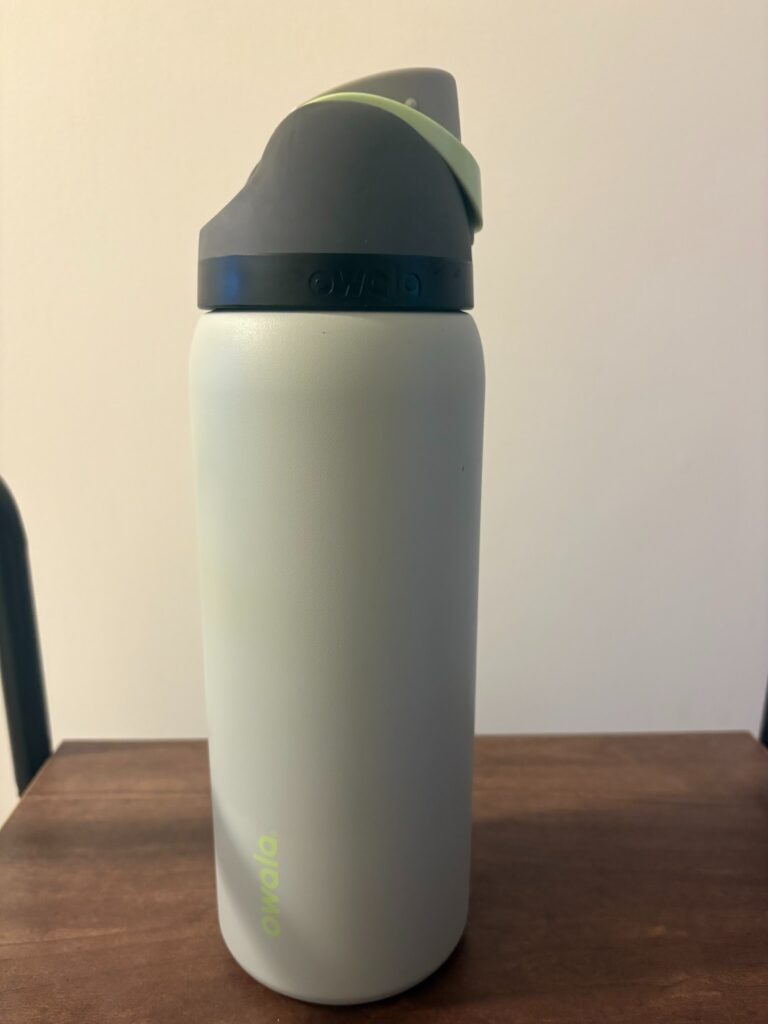
Figure 1. Full exterior view of the Owala FreeSip 24 oz water bottle, sage green colorway. Photograph by Omar Ramirez
4.2 Lid System
Although the body of the Owala is extremely important for it to function properly, the lid is just as important. The lid is the part of the bottle that essentially combines the multiple features of the Owala into one piece. The lid is small but composed of several parts. The button mechanism: the button on the lid is made of a high-quality, extremely durable plastic. This push mechanism ensures that the liquids within the bottle are kept safe, but it also ensures that the user is easily able to pop it open in order to get a quick sip. On top of this button, there is a built-in carrying loop, which not only secures the button but also helps give the user an easy way to carry their water bottle.
The lid is made up of several components: the button mechanism, hinge joint, silicone gasket, and a locking latch. All these parts make up the simple yet complex function. The silicone gasket is very minimal and almost invisible, but it’s there in order to create an extremely tight seal that helps prevent leaks. Alongside the silicone gasket, the locking latch within the lid is also essential for preventing leaks since it makes sure that the lid stays closed no matter what.
Figure 2. Close-up view of the Owala FreeSip lid, showing the carrying loop, push-button mechanism, and hinge assembly. Photograph by Omar Ramirez
4.3 The FreeSip Drinking Mechanism
Once you lift the carrying loop and push the button, and hear the click, the lid will open, and you will be greeted by Owalas’ trademark Free sip technology. This technology is extremely innovative; it gives the user two different ways of drinking their beverage, without having to switch parts or buy a new bottle.
The first method is tilting the bottle and drinking through its wide mouth opening. This option is for people who need to quickly chug a good amount of water and need to hydrate quickly.
The second method is by using the built-in straw. When using the straw, there is no need to tilt the bottle. You can hold the bottle upright and easily take a quick sip; the straw makes the drinking experience more controlled and reduces the risk of spillage.
The lid is designed in an extremely efficient manner; this two-way system makes the overall water drinking experience more seamless, but it also gives the user options they can use in order to keep themselves hydrated. One method allows for a quick, controlled sip, while the second method lets the user get a large amount of water down in a quick and smooth manner. Both designs keep the idea of functionality and efficiency in mind.
Figure 3. Interior view of the Owala FreeSip lid, showing the straw port and wide-mouth chug opening side by side. Photograph by Omar Ramirez.
4.4 The Insulation System
As mentioned before, the Owala has an insulation system that is exceptional at keeping liquids within the bottle extremely well. What it uses is a double-wall vacuum insulation, which consists of two layers of stainless steel with a space that is vacuum sealed, but how does this design work?
Qcond = (k × A × ∆T) / d
This formula seems pretty complicated at first glance, but it’s the formula that represents heat conduction. K is the thermal conductivity, the Ais the cross sectional area, ∆T is the temperature difference, and d represents the thickness. The vacuum seal seen in the Owala makes K closer to approaching 0, which in turn minimizes heat from moving in or out. Engineering Toolbox. (2019). Conductive Heat Transfer.
When holding the bottle, it feels at room temperature, but inside, the cool liquid remains cold. It’s almost like magic.
Figure 4. Bottom view of the Owala FreeSip, Photograph by Omar Ramirez.
5. Bottle Functions
The Owala free SIP is a fairly simple device, but extremely efficient. The design is fairly simple. In order to use the Owala, the user must fill up the body of the bottle with whichever cool liquid they like. After filling the bottle up, the user must tightly screw the lid back on in order to ensure that there’s no leakage. Once the lid is tightly screwed on, the user can press the push button, which will reveal the drinking sprout. As mentioned before, the Free sip technology gives the user the option to get a quick sip through a built-in straw, which works through suction, or chug the liquid by using the open-mouth design, which requires the user to tilt the bottle.
The Owala is great for daily use; it adapts to the user’s environment. In quieter and more relaxed environments. After the user is done using it, they can easily take it apart to clean it. All of its parts are easy to disassemble and reassemble, which makes it extremely simple to clean. Since the bottle is made out of stainless steel, users can also put the bottle in the dishwasher without having to worry about it getting damaged. All in all, the Owala has a design that is functional, convenient, and very simple to handle.
Figure 5. Owala FreeSip is fully disassembled, showing the bottle body, lid assembly, silicone gasket ring, straw, and spout cap. Photograph by Omar Ramirez.
Conclusion
The Owala free sip is a great modern-day design of a water bottle. It is very effective at its job and is still able to combine functionality, durability, and, more importantly, sustainability. It’s free sip technology, and the long-lasting materials it’s made up of make it an amazing, reliable option for staying hydrated.
This bottle is great for getting daily hydration, but it is also great at helping in the fight against plastic waste. Plastic waste is an issue that continues to grow, as it grows larger and larger, ecosystems get plagued, and our communities become dirtier, but you can stop it. Reusable water bottles prevent over 150 plastic bottles from entering landfills or oceans annually.McGimpsey, C. (2022). 5 Reasons to Opt for Reusable Water Bottles – Project Clean Water. Project Clean Water. This small change can save you money, but it can also save the planet.
In conclusion, the Owala is a perfect example of how purposeful engineering can improve something as basic as drinking water, all while helping the environment at the same time.
References
- Mallett, S. (2023a, January 8). The history of water bottles. Just Bottle. https://www.justbottle.co/blogs/insights/the-history-of-water-bottles?srsltid=AfmBOorBtlaWz4BE9WvdgYxO5IPhVkOfIk96gmENXZZa3T2VlZv2og1w
- Owala® FREESIP® bottle named to Time’s list of the best inventions of 2023. OwalaLife.com. (n.d.-a). https://owalalife.com/blogs/water-cooler/time-s-list-of-the-best-inventions-of-2023
- Conductive heat transfer. (n.d.). https://www.engineeringtoolbox.com/conductive-heat-transfer-d_428.html
McGimpsey, C. (n.d.). 5 reasons to opt for reusable water bottles – project clean water. Project Clean Water. https://projectcleanwater.org/5-reasons-to-opt-for-reusable-water-bottles/

